Environment
05.05.2018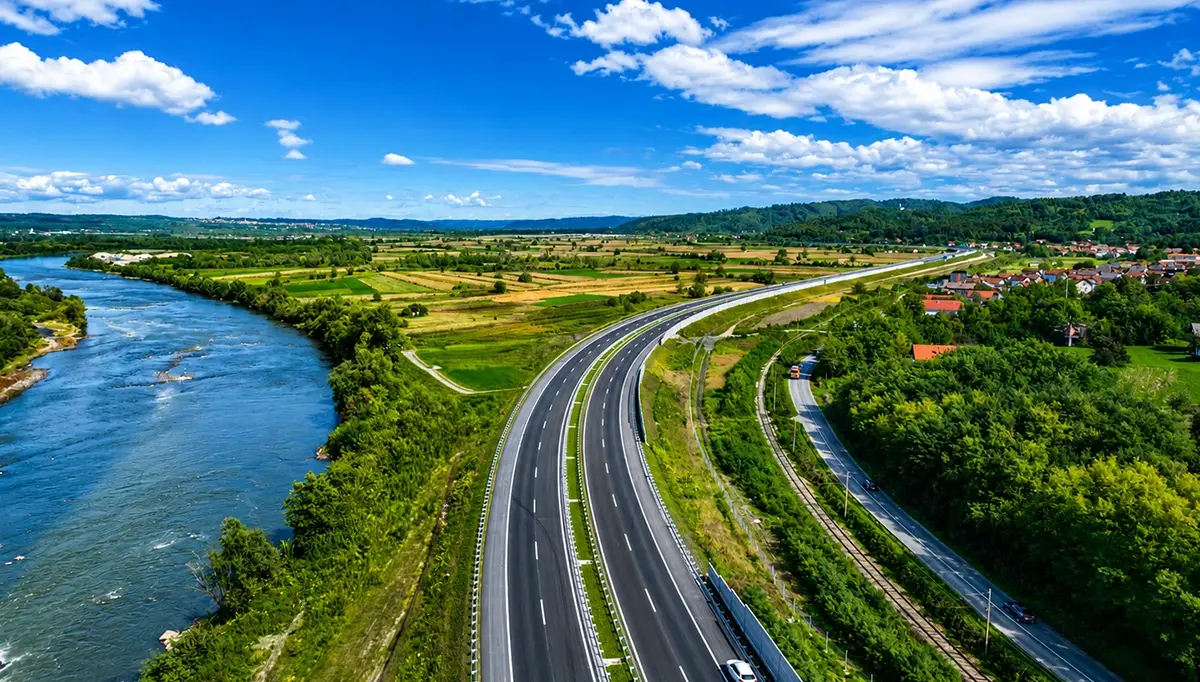
Environmental protection
The construction of highways and expressways has a significant and long-term impact on the environment, which is reflected in the disruption or division of habitats into smaller areas, the removal of vegetation, higher noise levels, and the risk of air and groundwater pollution.
Therefore, the obligation to prevent or mitigate the negative impacts of construction on the environment is prescribed by the laws and by-laws of the Republika Srpska that treat the field of environmental protection, and which the Public Enterprise Autoputevi RS adheres to in the planning, design, construction, use, and maintenance phases of highways and expressways.
In accordance with the Law on Environmental Protection of the Republika Srpska, or the Regulation on Projects for Which an Environmental Impact Assessment is Conducted, an environmental impact assessment is mandatory for the construction of facilities such as highways and expressways. This procedure is detailed and lengthy, and the process of approving the Impact Study necessarily includes the opinion of the interested public.
After the Decision on Approval of the Impact Study, the procedure for issuing an environmental permit follows. According to the Law on Spatial Planning and Construction of the Republic of Srpska, as part of the procedure for issuing a construction permit, the investor is obliged to obtain an environmental permit in advance. In other words, for such projects, without an environmental permit, there is no construction permit.
All sections of highways in the Republic of Srpska have valid environmental permits, which, by law, are renewed every 5 years. The environmental permit prescribes measures to prevent the risk of pollution, or when this is not feasible, measures to mitigate negative impacts on the environment to prevent pollution of surface and underground watercourses, air pollution, protect the population from traffic noise and dust, and as a protective measure, horticultural landscaping is also carried out, which reduces pollution, prevents soil erosion, and takes care to ensure that the highway blends into the natural environment. The Ministry issues a decision on the renewal of the environmental permit based on evidence that all its conditions have been met, i.e. that all environmental parameters have been regularly monitored in the past five years, which means measuring the specified parameters of water, air, soil, noise, a report on flora and fauna, etc., and that the monitoring reports show results within the permitted limits, which indicates stable environmental quality.
Environmental and social policy of international banks
In addition to the previously described domestic regulations that are increasingly harmonized with European directives on environmental impact assessment and protection, PE Autoputevi RS, since its establishment, has respected and implemented the environmental and social policies of European development banks that finance the construction of highway sections in the Republika Srpska. An Environmental and Social Management Plan (ESAP), a Stakeholder Engagement Plan (SEP), a Land Acquisition and Resettlement Plan (LARP) and other documents are developed and implemented in accordance with international environmental and social standards, which are made available for public inspection in the municipalities covered by the project at the beginning of the project and, of course, published on the website of the Public Enterprise Autoputevi RS. At the beginning of each project, a complaints mechanism is also established through which residents and all other interested parties can file complaints, remarks, or ask questions to both the contractor and the investor. The complaint form can be found on the website of the Public Enterprise Autoputevi RS or from the contractor at the construction site camp. Of course, complaints can also be submitted in person, by telephone, or in writing.
- Жалбени образац
- Жалбени образац
Public involvement takes place at all stages of the project. During construction, in accordance with the environmental and social policies of international banks, so-called public consultations are regularly held in the municipalities covered by the project, where local communities covered by the project and all other interested parties are invited. At such consultations, the investor and the contractor present the progress of the project and answer questions from those present.
ISO 14001 Standard – Environmental Management Systems
In addition to implementing domestic regulations and international environmental and social policies, JP Autoputevi RS has demonstrated its commitment to environmental protection by introducing the ISO 14001 standard. This international standard also sets requirements that enable a company to systematically manage environmental protection in its operations, to fulfill its obligations in this area by preventing or mitigating harmful impacts on the environment, or to influence the way in which the company's products/services will affect the environment.
The work of the Environmental Protection Service in JP Autoputevi RS is based on the following legal and regulatory acts:
- Law on Environmental Protection of the Republic of Srpska
- Law on Nature Protection of the Republic of Srpska
- Law on Spatial Planning and Construction of the Republic of Srpska
- Law on Public Roads of the Republic of Srpska
- Law on Forests of the Republic of Srpska
- Law on Agricultural Land
- Law on Waters of the Republic of Srpska
- Law on Air Protection of the Republic of Srpska
- Law on Waste Management of the Republic of Srpska
- Rule on Projects for Which an Environmental Impact Assessment is Conducted
- Instructions on the Content of an Environmental Impact Study
- Rule on Facilities That May Be Built and Put into Operation Only if They Have an Environmental Permit
- Rule on the Content of a Strategic Environmental Impact Assessment Report
- Rule on Criteria for Deciding on the Need for a Strategic Environmental Impact Assessment
- Rule on Conditions for Discharge of Wastewater into Surface Waters
- Rule on Conditions for Discharge of Wastewater into Public Sewers
- Rule on categories, testing and classification of waste
- Rule on permissible noise intensity limits
- Rule on permissible quantities of hazardous and harmful substances in agricultural soil and irrigation water and methods for their testing
- Rule on the content of remediation and reclamation projects
- Rule on special technical and technological solutions that enable unhindered and safe communication of wild animals
- Regulation on air quality values
Environmental permits:
- Vukosavlje - Brčko
- Rača - Bijeljina
- Bridge on Sava
- Loop airport Banja Luka
- Coridor 5c
- Banja Luka - Doboj
- Gradiška - Banja Luka
- Коридор 5ц.pdf
- Градишка - Бања Лука.pdf
- Бања Лука - Добој.pdf
- Петља аеродром Бања Лука
- Вукосавље - Брчко
- Рача - Бијељина
- Мост на Сави